Texto y Fotos : José Manuel Serrano Esparza
El 19 de noviembre de 2023 tuvo lugar con gran éxito de público (unas 6.000 personas) y de organización el II Enduro Guzmán El Bueno Obejo-Cerro Muriano, un evento motociclístico de gran nivel que se ha consolidado plenamente en tan sólo dos años de existencia, con masiva afluencia de espectadores, asombrando a propios y extraños.
Organizado por el Enduro Córdoba Off Road Club y el Moto Club de Posadas, con el apoyo de la Diputación de Córdoba, Imdeco, el Ayuntamiento de Córdoba, el Ayuntamiento de Obejo-Cerro Muriano, la Delegación de Medio Ambiente de la Junta de Andalucía, la X Brigada Guzmán el Bueno de Córdoba y decenas de patrocinadores, la prueba fue valedera para el Campeonato de Enduro de Andalucía y Extremadura.
Era mucha la expectación que se había generado tras el I Enduro Obejo-Cerro Muriano celebrado en noviembre del año anterior, también con gran éxito e insólita cantidad de espectadores (unos 5.000), y ciertamente, este II Enduro Guzmán el Bueno Obejo-Cerro Muriano 2023 fue todavía más una experiencia inolvidable para cualquier amante de las motos en general y del enduro en particular.
VERIFICACIÓN ADMINISTRATIVA DE PILOTOS EL SÁBADO 18 DE NOVIEMBRE DE 2023 ENTRE 16:00 H Y 19:15 H
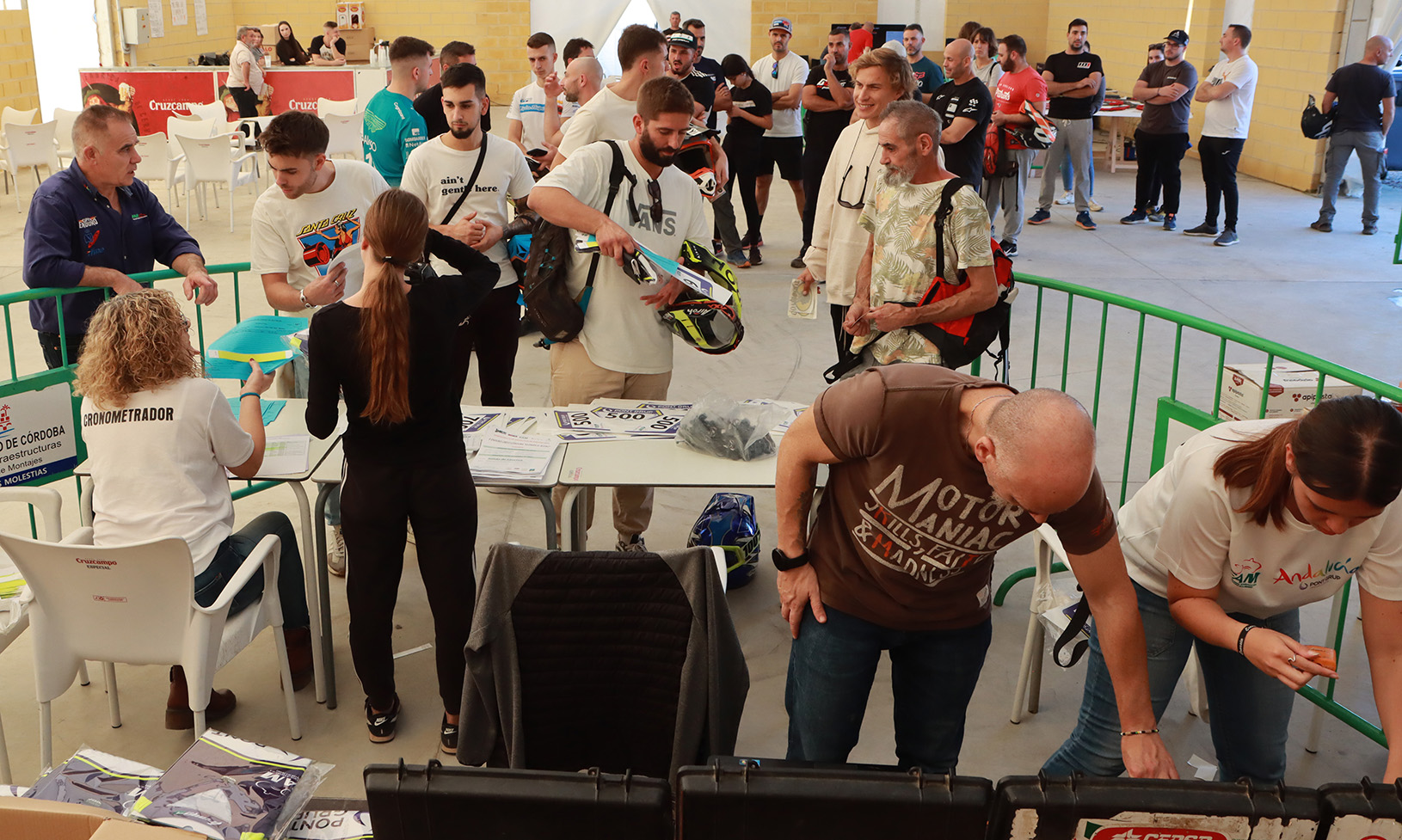
El 18 de noviembre de 2023, un día antes de las competiciones propiamente dichas, tuvo lugar entre las 16:00 y las 19:15 h la verificación administrativa de los 160 pilotos y sus motos, realizada por profesionales de la Federación Andaluza de Motociclismo, cuya experiencia y buen hacer fue fundamental para que todo se desarrollara de modo fluido, algo que no era fácil, a tenor de la gran cantidad de participantes.
Los numerosísimos pilotos acudieron puntuales a su cita y generaron un gran torrente humano
que llenó por completo la gran carpa situada a pocos metros del polideportivo de Cerro Muriano.
Así pues, durante las tres horas y cuarto de verificación administrativa se formaron grandes colas que iban más allá de la puerta principal de esta gran carpa que el sábado 18 de noviembre de 2023 se convirtió en el centro neurálgico de actividades previas a las impresionantes competiciones que tendrían lugar el día siguiente.
Se palpaba ya en el ambiente una atmósfera muy especial de apasionados de las motos de distintas edades, todos ellos sin cura posible y sin voluntad alguna de encontrar ningún antídoto.
Algo muy visible en la expresión facial de los pilotos, que revelaba una gran alegría y ganas de competir,
inmersos ya en una experiencia motociclística y humana en la que pese a que todos quieren ganar en sus respectivas categorías, lo más importante es compartir durante dos días todo tipo de experiencias, vivencias y anécdotas inolvidables, presididas por ese genuino espíritu motero de camaradería y ayuda mutua que siempre ha caracterizado a este maravilloso mundo de las máquinas de dos ruedas, que con frecuencia suele generar amistades para toda la vida.
Las mesas con profesionales de la Federación Andaluza de Motociclismo están funcionando como un reloj suizo, porque es necesario simultanear con la máxima precisión posible tanto esta verificación administrativa de pilotos como la verificación técnica de motos,
para dar paso después al briefing informativo que tendrá lugar entre las 19:30 h y las 20:30 h.
Se percibe claramente que la Federación Andaluza de Motociclismo en eficaz sinergia con el Enduro Córdoba Off Road Club han planificado todo con muchísimos meses de antelación, supervisando una pléyade de datos, además de elaborar las listas de pilotos y preparar todo el material y documentación que se ha de entregar a cada uno de ellos.
VERIFICACIÓN TÉCNICA DE MOTOS EL SÁBADO 18 DE NOVIEMBRE DE 2023 ENTRE 16:15 H Y 19:30 H
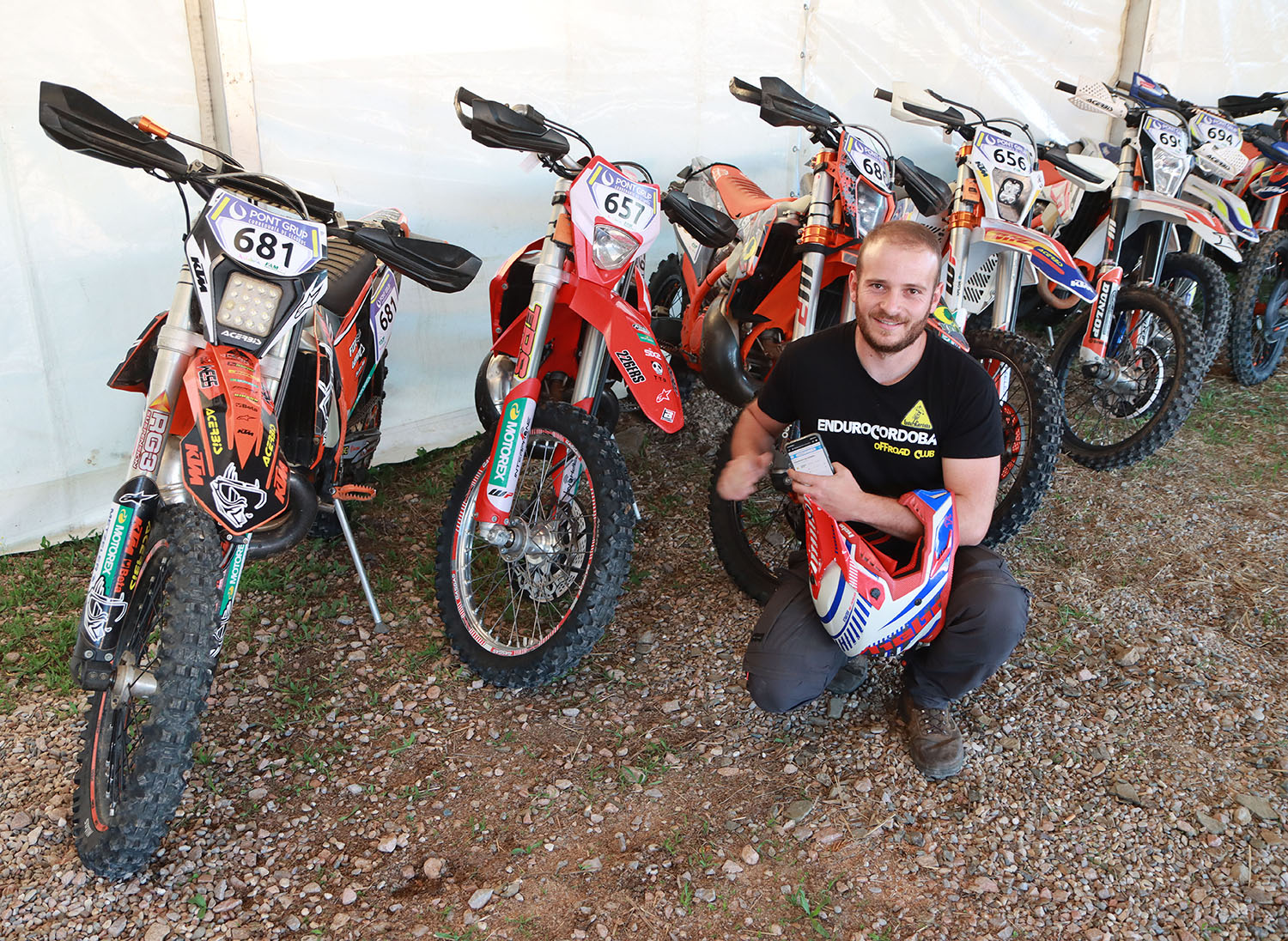
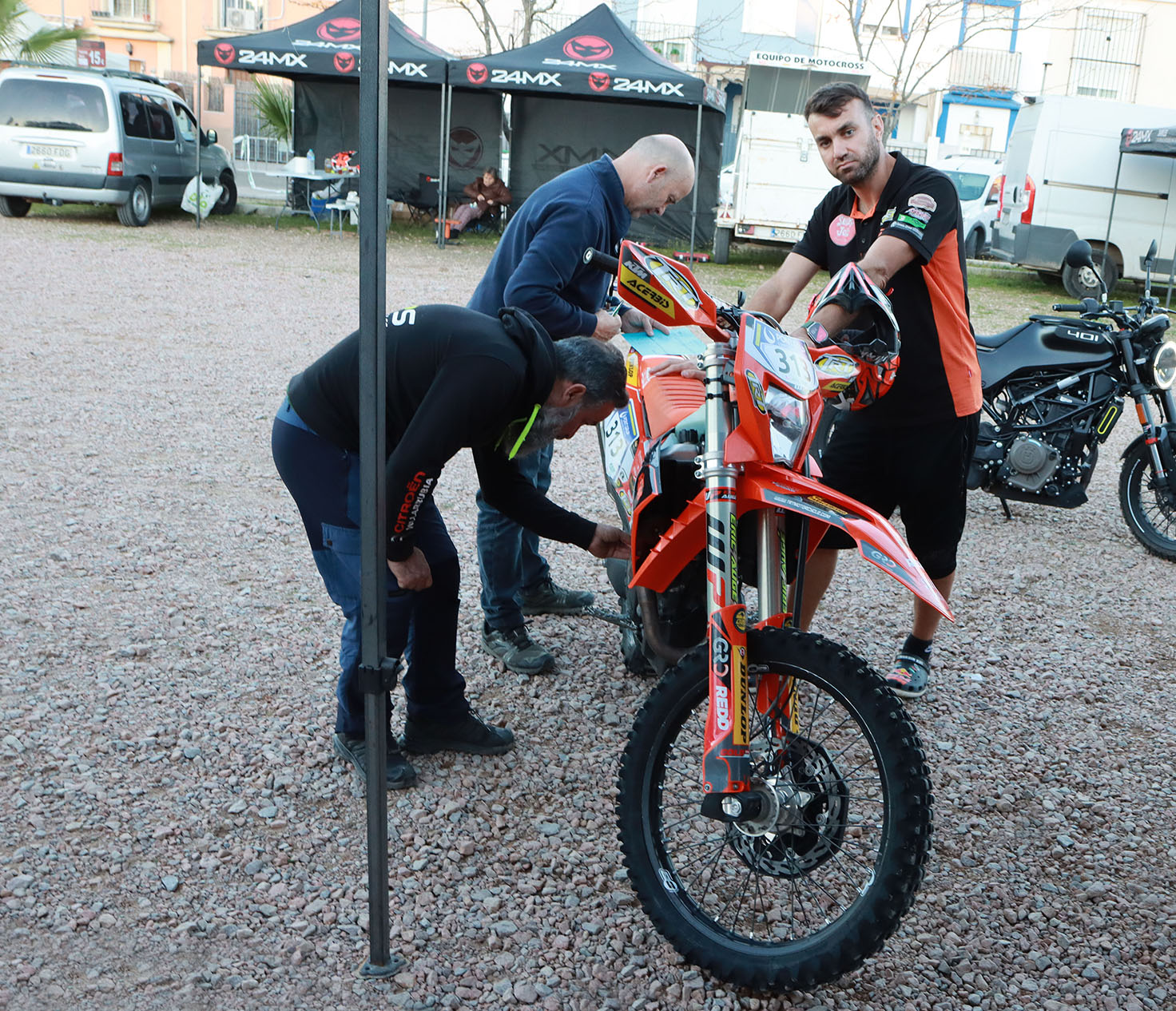
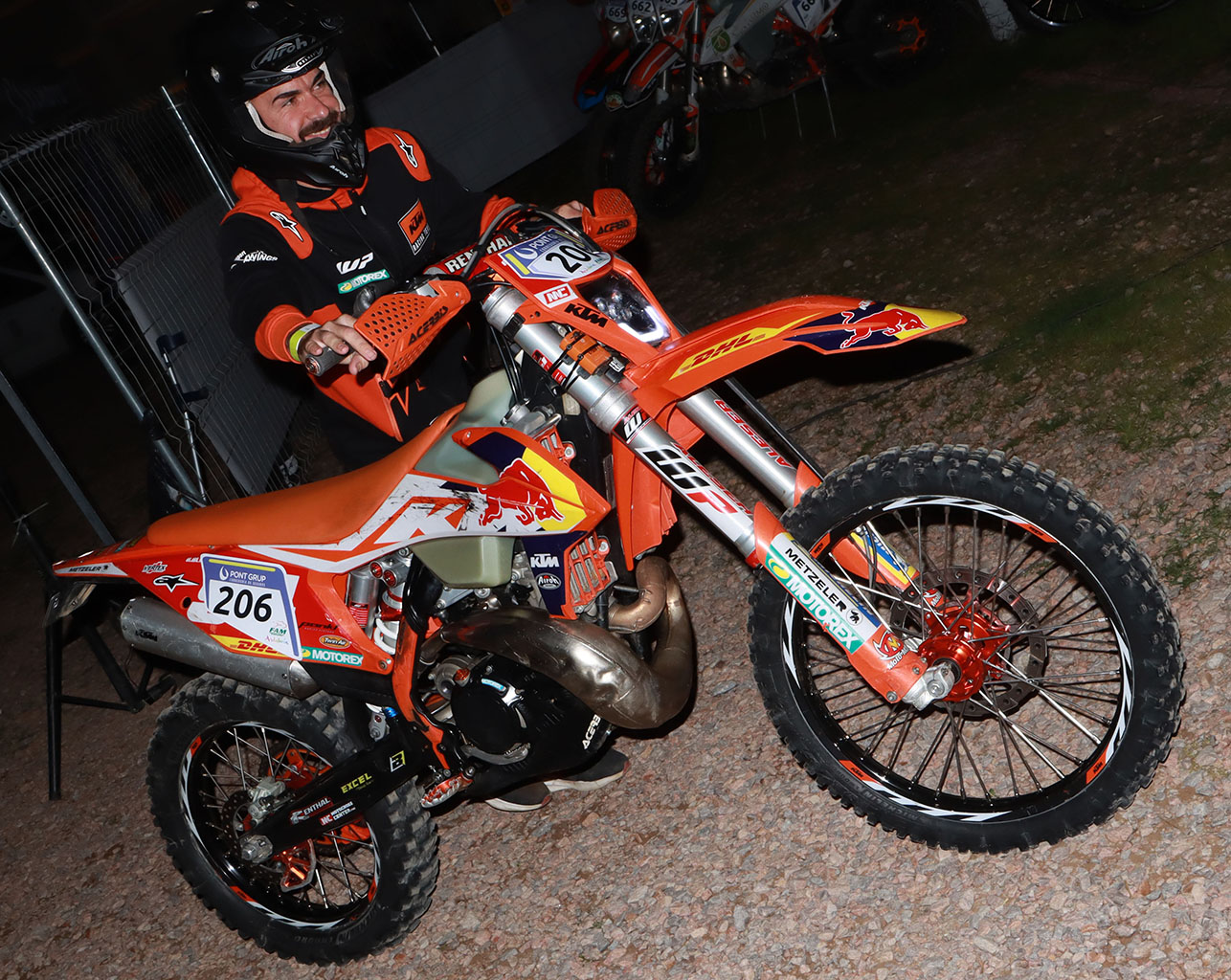
La cantidad de motos inscritas fue de 160, una impresionante cifra para una prueba de estas características, de tal manera que la verificación técnica del sábado 18 de noviembre de 2023 se convirtió en un espectacular desfile de motos, en el que brillaron tanto los pilotos y sus máquinas como los miembros de la Federación Andaluza de Motociclismo, que con su experiencia y conocimiento hicieron posible la fluidez de esta fase que un año más se prolongó varias horas como consecuencia del gran número de motos participantes, con pilotos procedentes no sólo de Córdoba, sino también de otras provincias de toda España :
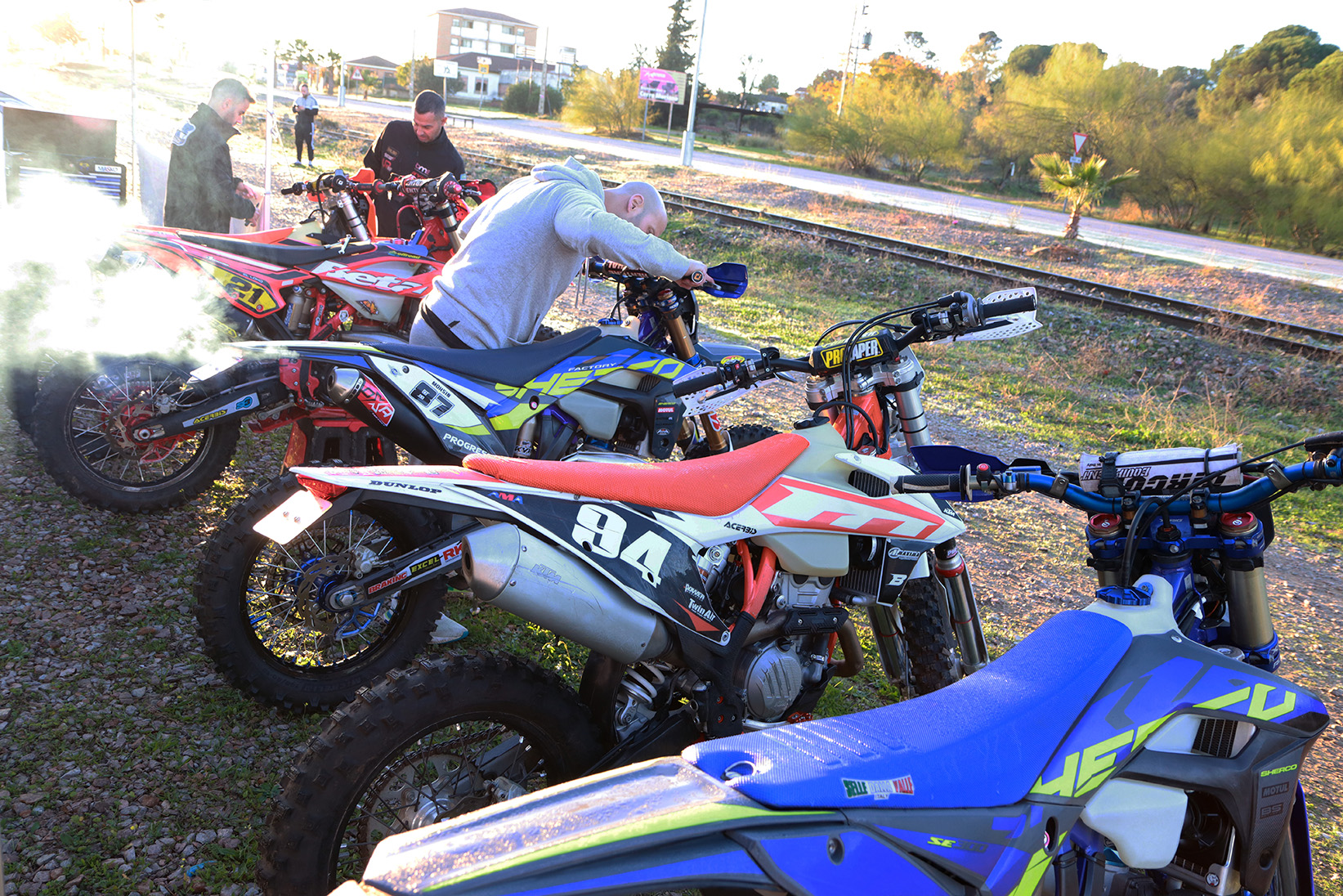
una fiesta del motor con máquinas de dos ruedas de distintas marcas (KTM, Husqvarna, Beta, Sherco, Rieju, Gas Gas, etc) con distintas filosofías y tecnologías, así como motores 2T y 4T.
En el marco de un deporte que tiene cada vez más seguidores
y del que el Enduro Cerro Muriano Guzmán el Bueno es un fiel exponente.
Es además una prueba deportiva que se celebra en la puerta de Sierra Morena y el Valle del Guadiato, con unos espléndidos paisajes.
Por otra parte, es impresionante como el deporte de las motos aglutina a personas de las más diversas procedencias, profesiones, creencias y zonas de España,
hasta el punto de que se genera una especie de familia en la que todo el mundo se ayuda,
en sincero altruismo inherente a este entorno deportivo, en simbiosis con un gran ambiente, en el que
motos y pilotos forman una gran familia, en la que todos quieren ganar, pero donde lo más importante de todo es pasarlo bien
y disfrutar momentos irrepetibles que hagan de este singular fin de semana algo inolvidable para todos los participantes y los muchos miles de espectadores asistentes.
Hay una amplísima gama de motos de gran calidad y tecnología de vanguardia,
que destacan además por su belleza de líneas y la originalidad de los diseños de sus logotipos, etc,
complementados por las distintas indumentarias de los pilotos, que presentan una gran varieda de formas y colores,
al igual que las motos, cuya mera contemplación es ya per se un deleite visual,
y cuyo amplio surtido de sonidos producidos por plantas motrices tanto dos tiempos como cuatro tiempos con distintas configuraciones, es algo indescriptible y una experiencia sensorial única en su género.
Un mundo de cilindros, pistones, olor a gasolina, escapes, carburadores, manejo de las herramientas para poner a punto las motos, manos manchadas de grasa, aprendizaje incesante de mecánica, noches enteras en garaje con motos, etc.
Son motos mayormente con entrega de potencia suave, increíble maniobrabilidad, ligereza de máquina
y formidable relación peso / potencia de motor monocilíndrico, que constituye una de las más importantes señas de identidad de estas motos de enduro.
Es increíble el nivel de fidelidad y preservación de la pasión por el deporte del enduro que personas como ellos mantienen incólume durante toda su vida, con admirable energía.
Entusiastas de las motos que llevan muchos años intentando sacar horas de donde no las hay para poner a punto sus máquinas de dos ruedas, dotarlas con los mejores accesorios posibles y participar en competiciones repletas de emoción.
Una actividad deportiva que es también una vía de escape al stress diario, sin olvidar los dos años de pandemia que tanto hicieron sufrir a los amantes de las motos y de otros deportes de la más variada índole.
La expresión facial de los pilotos revela tanto tensión contenida como alborozo, porque todos están pensando ya en las competiciones del día siguiente,
donde intentarán dar la mejor versión de sí mismos y se esforzarán al máximo.
Ésto es un trasiego de motos que parece no tener fin, un espectáculo grandioso que congrega tanto a pilotos jóvenes como veteranos, en distintas categorías,
y que aunan esmero e ilusión a raudales que permite alcanzar importantes metas.
La exótica comitiva de motos prosigue sin descanso durante toda la tarde, durante la cual, tras la verificación técnica, los pilotos se dirigen con sus máquinas de dos ruedas hacia el paddock.
Durante todo este tiempo, los profesionales de la Federación Andaluza de Motociclismo apenas tienen momentos de respiro, comprueban todo con gran minuciosidad y dan constantes instrucciones a los pilotos,
que saben desde su más temprana adolescencia que el deporte del enduro es muy exigente desde un punto de vista físico, pero genera grandes satisfacciones y recuerdos inolvidables a sus incondicionales,
que dan gas y cabalgan a lomos de estas máquinas de dos ruedas de notable belleza y tecnología muy avanzada, porque consideran que ello es parte importante de sus vidas.
Un deporte en el que los pilotos tendrán que esquivar todo tipo de obstáculos ( troncos de árboles, contenedores, charcos con barro, tramos de terreno con distinta altura, montículos, grandes ruedas de tractor, etc) para llegar a la meta.
Una competición en la que los participantes deben preparar su cuerpo y su mente para obtener una buena resistencia,
con lo que conseguirán nivelar su adrenalina para obtener buenos resultados y a veces incluso subir al pódium y ganar carreras.
Ni que decir tiene que la experiencia juega un papel muy importante en el enduro,
una disciplina deportiva con motos cuyo motor ofrece una respuesta más progresiva,
por lo que el pilotaje es a veces más lento y muy técnico, porque hay que esquivar una amplia gama de obstáculos.
Son además motos diseñadas para las peculiaridades concretas de este deporte, por lo que la distribución del cilindro y la culata es algo elevada en comparación con otras de carreras más cortas,
lo cual permite que la carrera del pistón sea un poco larga.
Asimismo, las motos de enduro incluyen tubos de escape con catalizador, y la bufanda de escape está diseñada para ofrecer un mayor vigor en velocidad, de modo progresivo,
mientras que el embrague es un poco suave y permite un mejor tacto.
Es también importante destacar que la práctica de este deporte precisa muy buena forma física y mental para poder realizar con precisión las distintas maniobras,
por lo que la práctica constante y el entrenamiento favorece el desarrollo y una buena evolución en este deporte.
Los miembros de la Federación Andaluza de Motociclismo continúan con su infatigable labor de verificación técnica de las motos, fundamental para garantizar los mayores niveles de seguridad posible.
Siguen llegando más y más participantes con sus motos. El semblante de los pilotos refleja felicidad y muchas ganas de competir,
mientras llevan sus máquinas de dos ruedas al paddock,
pensando ya en las pruebas cronometradas que se celebrarán durante la siguiente jornada
y en las que los resistentes motores de sus máquinas de dos ruedas soportarán la dureza del terreno y los obstáculos y mostrarán su fiabilidad.
Otro componente importante del enduro es la capacidad mental en cuanto a concentración y resistencia,
dos aspectos esenciales en esta modalidad del motociclismo.
El paddock comienza a llenarse,
pero el desfile de motos prosigue sin descanso.
Es un espectáculo incomparable para cualquier amante de las motos offroad, cuya elegancia de contornos y vistosidad de colores alegran el día a todos los presentes.
Las motos de enduro adquieren pues un gran protagonismo durante esta verificación técnica,
tras la cual más y más motos van concentrándose en el paddock.
El aluvión de motos de enduro que llegan para la verificación técnica parece no tener fin,
y los pilotos aguardan su turno junto a sus máquinas,
mientras veteranos del offroad con gran conocimiento y experiencia comentan con satisfacción todo lo que está ocurriendo.
Son ya las 18:00 h de la tarde y los profesionales de la Federación Andaluza de Motociclismo prosiguen con la verificación técnica de motos cada vez más numerosas,
que son dirigidas hacia el paddock
y cuyos pilotos han venido a disputar este II Enduro Obejo-Cerro Muriano Guzmán El Bueno desde todos los rincones de la geografía nacional,
hasta el punto de que muchos de ellos han viajado cientos de kilómetros para poder estar aquí este fin de semana.
Cabe también destacar que el enduro es la especialidad más completa del motociclismo, porque precisa velocidad, resistencia, técnica y muchas más cosas,
algo que saben de sobra profesionales del sector como José Antonio Luque, que al igual que el resto de miembros de la Federación Andaluza de Motociclismo presentes en el evento, llevan décadas amando y practicando este deporte, del que son profundos conocedores.
Porque el enduro es un compendio del arte de montar en moto y es la especialidad motociclística que más ha evolucionado a lo largo de su historia.
Por otra parte, también es muy útil a los pilotos de enduro la lectura, el indagar en cuanto a estilos y trucos, la búsqueda de los mejores elementos de protección posibles, etc,
así como el intentar disponer en todo momento de sistemas de amortiguación de alta calidad,
sin olvidar el permanente aprendizaje como clave del éxito.
El tropel de motos de enduro participantes en la competición sigue su rumbo hacia el paddock tras la verificación técnica.
Son motos en las que sus elementos como embrague, llantas y amortiguaciones están pensadas para adaptarse al terreno y a la velocidad necesaria en cada tramo.
Un entorno en el que se prioriza el respeto por el medio ambiente.
Son ya las 18:30 h de la tarde y la verificación técnica de motos está en su apogeo, con abundantes pilotos esperando su turno.
Aquí vemos a otro de ellos, ataviado con un bello casco, que se dirige al paddock con su moto.
La variedad de cascos utilizados por los participantes, con sus diferentes formas, bellos diseños y originales variedades cromáticas,
fue otro de los grandes alicientes de esta competición,
cuyos participantes expresaron una y otra vez su satisfacción,
mientras se realizaba la comprobación de sus motos,
cuya estructura debe ser lo suficientemente resistente para mantener los neumáticos en las pistas.
Son también motos todo terreno, muy ligeras, ágiles y potentes,
con depósitos de combustible de notable tamaño y motores optimizados para una mayor longevidad y fiabilidad,
además de incorporar protectores de sumideros y componentes más pesados y duraderos que las motos de motocross, con las que comparte la amortiguación de largo recorrido.
Los motores son normalmente de un solo cilindro dos tiempos entre 125 cc y 360 cc y cuatro tiempos entre 195 cc y 650 cc.
El que las motos vayan propulsadas por motores 2T ó 4T es importante, dependiendo del uso que se les vaya a dar, y definirán la eficacia de la moto, la distribución de la potencia y el mantenimiento necesario.
Los motores 2T destacan por la enorme potencia para su cilindrada y extraordinaria eficiencia termodinámica, en simbiosis con su fabulosa regularidad de par motor, que hace que a igual cilindrada puedan generar el doble de potencia que un motor 4T.
Porque a diferencia de los motores 4T ( que necesitan dos vueltas de cigüeñal para realizar las cuatro etapas del ciclo termodinámico : compresión, combustión, expansión y escape),
los motores 2T realizan dichas cuatro etapas con sólo una vuelta del cigüeñal), además de que los motores 2T son más pequeños, ligeros y rápidos, tienen muchas menos piezas móviles y utilizan el cárter para la precompresión, mientras que en los 4T el cárter no desarrolla ninguna función del ciclo termodinámico.
Por su parte, los motores 4T tienen una distribución de potencia más equilibrada y suave, aunque son más pesados y complejos, por lo que su mantenimiento es menos sencillo.
Por otra parte, las motos de enduro se caracterizan por una caja de cambios y modificaciones especiales en las amortiguaciones para resistir los desafíos del terreno.
También fue relevante la participación de muchos pilotos veteranos,
que siempre son un ejemplo para los más jóvenes.
Es importante también subrayar que las motos de enduro son matriculables, por lo que pueden circular por la vía pública sin problemas.
Con respecto a sus chasis, se busca en ellos sobre todo protección y manejabilidad,
en sinergia con la llanta delantera que tiene un tamaño de 21 pulgadas y la trasera que mide 18 pulgadas.
Durante toda esta fase hubo un gran ambiente motero presidido por la alegría y la solidaridad colectiva,
como preludio de la gran jornada de competiciones cronometradas que tendría lugar el domingo 19 de noviembre de 2023.
Un clima pues de camaradería y grandes emociones latentes que se materializarían al día siguiente.
A las 18:45 h de la tarde continúa la verificación técnica de motos, que siguen llegando de modo ininterrumpido,
mientras los mimebros de la Federación Andaluza de Motociclismo comprueban que todo está correcto.
Ésto no para, y los pilotos siguen reflejando en su rostro notables dosis de júbilo,
mientras reciben instrucciones antes de llevar sus motos al paddock.
Son ya las 19:05 h de la tarde y se sigue trabajando a destajo tanto en la zona de verificación técnica de motos como en el tramo de acceso al paddock.
Hay muchas personas entusiastas del off road congregadas en todas las áreas adyacentes al polideportivo de Cerro Muriano.
La luz cada vez es menor y algunos empiezan a encender los faros.
La profusión de motos es inenarrable, con un constante ir y venir de pilotos y profesionales de la Federación Andaluza de Motociclismo.
Hace ya bastante rato que el paddock se asemeja por momentos a una pasarela de motos de enduro,
donde los pilotos buscan el lugar en el que dejarán aparacadas sus motos hasta el día siguiente
en que tendrán lugar las distintas competiciones.
Son ya las 19:10 h. Quedan todavía 20 minutos de verificación técnica, cuyo final está previsto para las 19:30 h,
pero siguen llegando más y más pilotos con sus flamantes motos de enduro.
Son muchos los padres participantes que posan junto a sus motos con sus hijos y familiares más allegados.
Más y más pilotos siguen llegando con sus motos a la zona de verificación técnica y al área del paddock,
con visible felicidad en su mirada, porque han sido muchos meses de espera
hasta la celebración de este fin de semana tan anhelado.
Son ya las 7: 15 h, y la tenue luz previa al crepúsculo hace refulgir sobremanera las motos de enduro en el paddock,
donde nuevos pilotos siguen aparcando sus máquinas de dos ruedas.
Los profesionales que realizan la verificación técnica de motos no dan abasto y hay todavía una larga fila de pilotos y motos esperando.
Es una comitiva exótica en la que estas atractivas motos de enduro exhiben su belleza de líneas, distintas soluciones tecnológicas y una amplia variedad de colores que realzan sus formas.
Pilotos y motos avanzan como un todo indisoluble, en dirección hacia el paddock.
Son motos muy versátiles, diseñadas para poder afrontar distintos terrenos y tramos difíciles,
dotadas con chasis reforzados y resistentes, que pueden soportar el, stressm y los impactos asociados con la conducción off road.
Poseen también amortiguadores diseñados para absorber los golpes y ofrecer un largo recorrido, con lo que se obtiene un mejor control y tracción en terrenos irregulares.
Por otra parte, estas motos de enduro incorporan neumáticos 100% off road, que ofrecen un mayor agarre en terrenos variados, tienen un dibujo más profundo y su construcción es muy robusta, para optimizar la tracción y estabilidad,
sin olvidar la respuesta rápida del acelerador que ofrecen los potentes motores tanto de dos tiempos como cuatro tiempos, según las preferencias personales, que incorporan las motos de enduro,
cuyos sofisticados sistemas de escape consiguen un excelente rendimiento en potencia y respuesta del motor.
BRIEFING INFORMATIVO EL SÁBADO 18 DE NOVIEMBRE DE 2023 ENTRE 19:30 H y 20:30 H
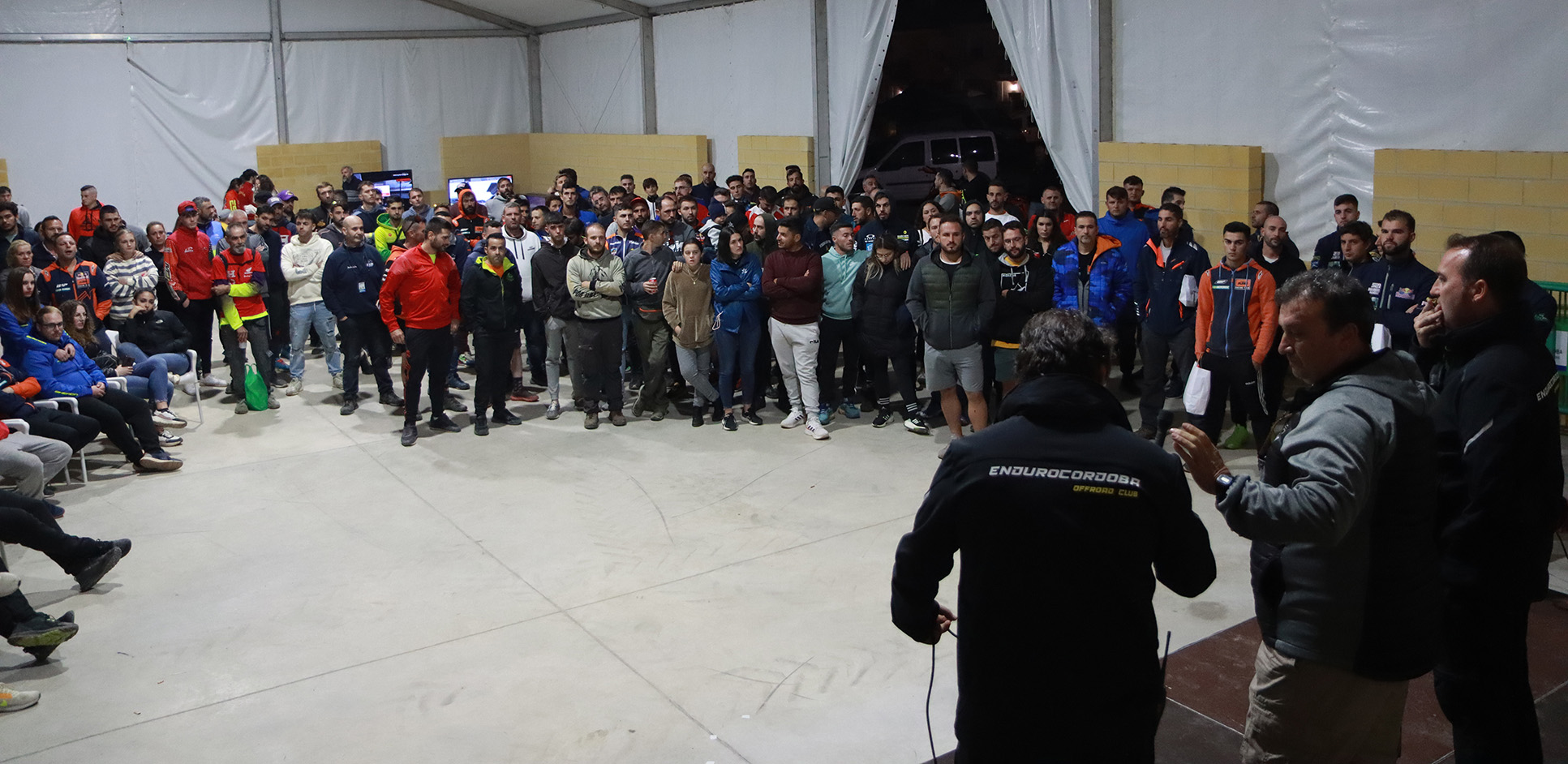
El sábado 18 de noviembre de 2023 tuvo lugar entre las 19:30 h y las 20:30 h el muy importante briefing informativo en el que Antonio Mata ( muy experimentado miembro de la Federación Andaluza de Motociclismo) y varios miembros del Enduro Córdoba Off Road Club
explicaron al numerosísimo público asistente las normas fundamentales de seguridad, etc, a cumplir durante las competiciones del día siguiente.
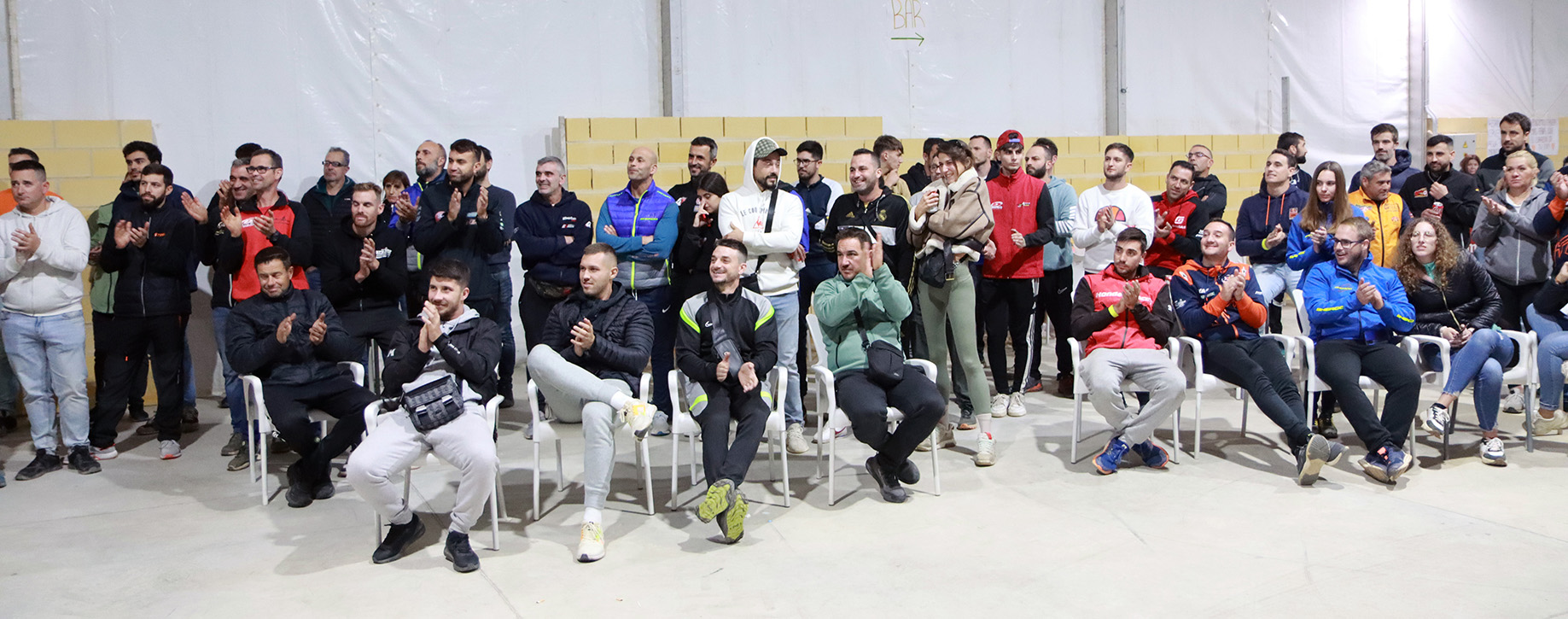
De repente, al cabo de pocos minutos, el público comienza a aplaudir con ganas y durante muchos segundos ininterrumpidos, algo que seguirá sucediendo durante la hora de duración del briefing.
Están aquí prácticamente todos los pilotos, muchos familiares y amigos y la mayoría de integrantes del Enduro Córdoba Offroad Club.
Todos saben que este II Enduro Obejo-Cerro Muriano Guzmán El Bueno había sido autorizado por la RFME y la FAM como carrera puntuable para el Campeonato de España los días 18 y 19 de noviembre dde 2023, pero tan sólo una semana después de conocerse la noticia, la FIM (Federación Internacional de Motociclismo) comunicó que los Six Days 2023 se celebrarían en Argentina entre el 6 y el 11 de noviembre, por lo que la RFME explicó al Enduro Córdoba Offroad Club que por incompatibilidad de fecha con los Six Days de Argentina, no sería posible la celebración de la II Enduro Obejo-Cerro Muriano 2023 como prueba para el Campeonato de España, porque las motos y todo el material de las distintas marcas tardarían casi un mes en regresar a España en barco tras la finalización de los Six Days.

Poco después, la RFME, plenamente consciente del enorme esfuerzo de muchos años que había realizado el Enduro Córdoba Offroad Club para organizar el II Enduro Obejo-Cerro Muriano Guzmán el Bueno 2023 como prueba del Campeonato de España, les ofreció hacer la prueba en Abril de 2023,
Fue a partir de ese momento cuando el Enduro Córdoba Offroad Club aceptó con gran deportividad y estoicismo la situación, renunciando a hacer la prueba en dicho mes, porque les era imposible preparar el evento en tan poco tiempo con la supervisión y profesionalismo que siempre les ha caracterizado, de modo que decidieron hacer el II Enduro Obejo-Cerro Muriano Guzmán El Bueno 2023 en las fechas señaladas, es decir, el 18 y 19 de noviembre de 2023.
Antonio Mata, Delegado de la Federación Andaluza de Motociclismo, explica a los muchísimos pilotos reunidos una serie de normas de obligado cumplimiento que han de garantizar la seguridad y buena marcha de las competiciones cronometradas y el rally de 40 km que se celebrarán al día siguiente,
mientras los asistentes, que llenan por completo la gran carpa junto al polideportivo de Cerro Muriano, no dejan de aplaudir
y escuchan con atención.
Se suceden los vítores y aplausos por parte de los asistentes a este briefing, cuyas caras reflejan una gran intensidad emocional.
Es ahora José Córdoba (Vicepresidente del Enduro Córdoba Offroad Club) quien toma la palabra e insiste en la necesidad de cumplir las normas de seguridad y respeto al medio ambiente que han caracterizado a esta competición desde su nacimiento en 2022.
El público sigue aplaudiendo sin parar, conscientes del enorme esfuerzo que han realizado el Enduro Córdoba Offroad Club y la Federación Andaluza de Motociclismo para preservar esta fantástica competición y sacarla adelante.
Poco después, toma la palabra Rafael Pérez (Presidente del Enduro Córdoba Offroad Club), cuya alocución sintetiza con precisión las palabras pronunciadas anteriormente por Antonio Mata y José Córdoba : es fundamental para la buena marcha de este evento motociclístico seguir fielmente las normas de seguridad.
Asimismo, Rafael Pérez agradece su presencia a todos los pilotos, familiares y amigos que han tenido la amabilidad de venir desde distintos lugares de la provincia de Córdoba y otras muchas zonas de España para participar en este II Enduro Obejo-Cerro Muriano Guzmán El Bueno,
mientras prosiguen los aplausos, en medio de un crisol de sentimientos y emotividad a flor de piel,
preludio de la gran jornada motociclística que se vivirá el día siguiente 19 de noviembre de 2023 y en el que están pensando ya todos los espectadores,
que son grandes entusiastas del enduro.
COMPETICIONES MUY ESPECTACULARES EL DOMINGO 19 DE NOVIEMBRE DE 2024
PRUEBA CRONOMETRADA A TRAVÉS DE 3 KM DE ZONA DE CAMPO, CON FABULOSOS ESCENARIOS NATURALES MÁS ALLÁ DE LA VÍA FÉRREA CÓRDOBA-ALMORCHÓN, EN DIRECCIÓN OESTE
La prueba cronometrada a través de campo, con bellísimo trazado de majestuosos paisajes al oeste de la vía férrea Córdoba-Almorchón hizo las delicias de los miles de espectadores que llenaban sus distintos tramos desde aproximadamente las 8:00 h de la mañana del domingo 19 de noviembre de 2023, una jornada en la que todo el mundo disfrutó al máximo del off road.
El muy numeroso público asistente pudo ver in situ como los pilotos, con sus aptitudes y destrezas para el enduro, realizaban una amplia variedad de saltos,
aceleraciones,
derrapes,
frenadas, etc, escuchándose de modo simultáneo el poderoso bramido de los motores,
todo ello con una gran precisión en las trazadas con la moto,
para ganar tiempo y arañar valiosas décimas de segundo.
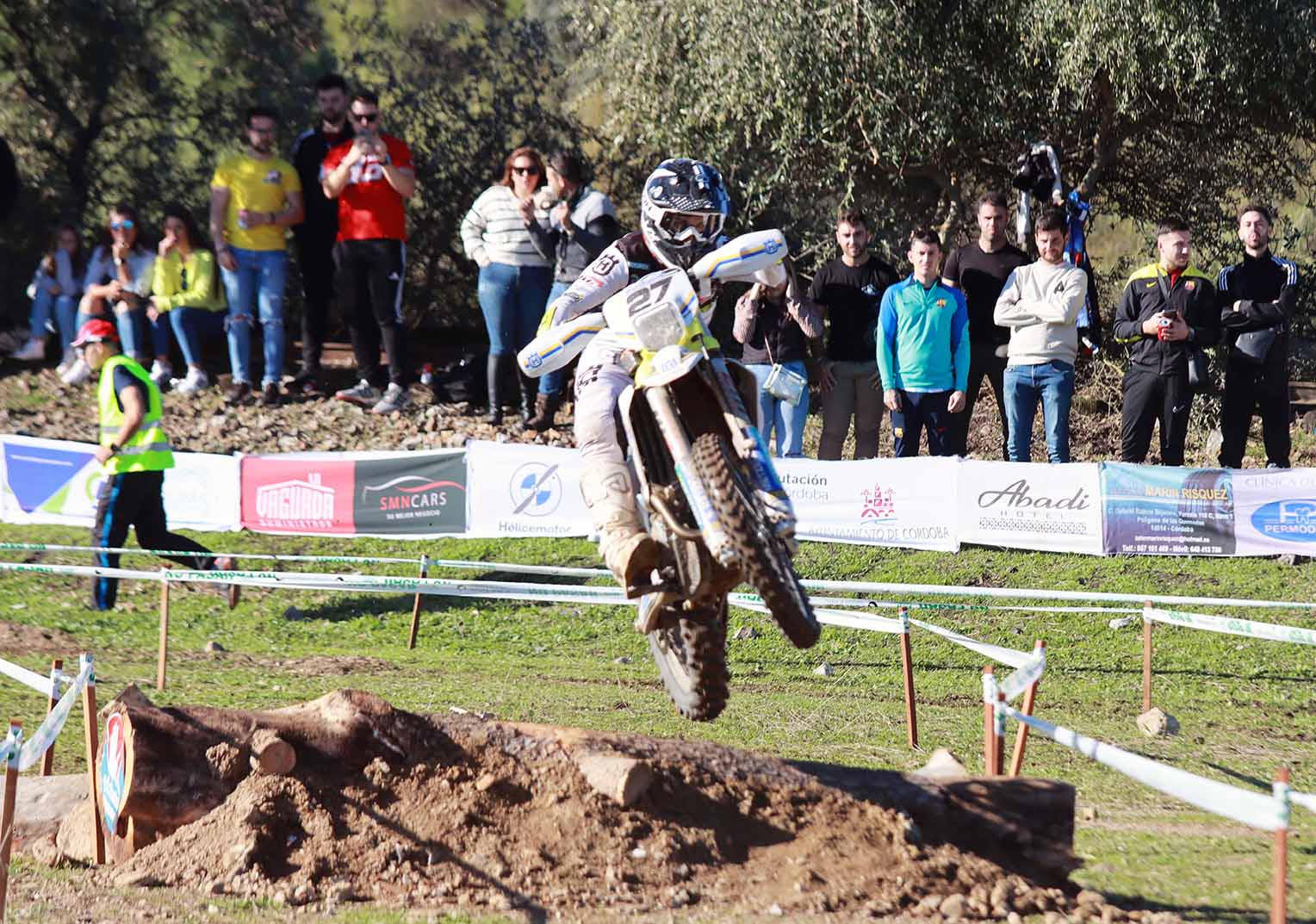
El carrusel de saltos en los que los pilotos pusieron a prueba sus motos, volando de modo muy espectacular, hizo las delicias del público,
alcanzando la emoción cotas indescriptibles en los espectadores, que pudieron ver desde muy cerca la pléyade de maniobras de los pilotos y la estela de polvo que dejan tras ellos,
así como la pericia con la que superaban los obstáculos,
tanto cuando la moto estaba en el aire
como cuando evolucionaba a través de este mágico trazado diseñado por Julio Sojo Jiménez, profundo conocedor de la zona y enamorado del enduro desde su infancia.
PRUEBA EXTREME, DISPUTADA EN EL CIRCUITO SITUADO CERCA DEL POLIDEPORTIVO DE CERRO MURIANO
Es la modalidad en la que los pilotos realizan las maniobras, derrapes, saltos y movimientos más espectaculares en el circuito de 400 x 300 metros situado en las proximidades del Polideportivo Municipal de Cerro Muriano y la zona de Boxes / Parking Caravanas.
Sergio Navarro, Campeón del Mundo, en plena prueba extreme ante el numerosísimo público congregado.
Esta fotografía estuvo expuesta durante la Feria FITUR 2023 en el Pabellón de Turismo de Córdoba entre el 18 y el 22 de enero de dicho año.
El potencial motriz y visual de esta competición es impresionante,
demostrando los pilotos una y otra vez su gran pericia y habilidad mientras cabalgan sus motos, con impresionantes saltos en los que las máquinas de dos ruedas vuelan de modo alucinante,
catalizando oleadas de admiración entre el público presente que contempla atónito este singular espectáculo,
en el que además se superan con gran habilidad todo tipo de obstáculos, en medio de un incomparable entorno natural constituido por el paisaje de esta zona que es la puerta de Sierra Morena
y las vías de la antigua línea férrea Córdoba-Almorchón junto a las que se sitúan muchos espectadores para ver evolucionar las motos desde muy cerca. Puede apreciarse en imagen como uno de los espectadores corre para conseguir el mejor lugar de observación posible.
La estética visual del enduro como competición offroad es ciertamente única, por lo que las maniobnras muy vistosas y de nada fácil realización fueron algo coinstante durante esta inolvidable jornada en la que el enduro del máximo nivel llegó a Obejo-Cerro Muriano (Córdoba).
La habilidad con sus motos y pericia mostrada por los pilotos participantes en esta crono extreme fue verdaderamente admirable.

Por otra parte, el singular paisaje formado por las cintas que delimitan el itinerario que han de seguir los pilotos de esta competición crono enduro extreme es otro aspecto muy atractivo de la misma.
Un evento en el que destacó además la gran presencia de mujeres entre los espectadores,
cuya gran proximidad con respecto a pilotos y motos constituye otro importante aliciente más de las competiciones offroad.
El ritmo trepidante de las motos y el sonido de sus motores monocilíndricos de muy avanzada tecnología
fue un deleite para los sentidos y para cualquier apasionado de las motos,
que disfrutaron plenamente los muchísimos espectadores que asistieron al evento
y tuvieron oportunidad de contemplar el gran esfuerzo constante de los pilotos,
cuya variedad de estilos de pilotaje fue otro de los aspectos más relevantes de este II Enduro Obejo-Cerro Muriano Guzmán El Bueno 2023.
Obsérvese este espectacular salto de uno de los pilotos participantes, bajo la atenta mirada de uno de los miembros del Enduro Córdoba Offroad Club.
Aquí, otro de los pilotos participantes cruza con habilidad y a gran velocidad un charco con barro. Es en situaciones como esta donde las plantas motrices de las motos de enduro muestran su fiabilidad, incluso en las condiciones más duras,
impulsando también las motos de modo que puedan superar los distintos obstáculos
que constituyen esta prueba extreme en la que los pilotos acreditan su gran valor, en medio de
la indescriptible emoción y frenesí inherente al enduro extreme como factores definitorios de este deporte.
Alcanzar este nivel precisa muchos años de experiencia, haberse caido muchas veces y levantarse de nuevo, además de una gran pasión y amor por el enduro,
que se traduce en entusiasmo colectivo de todos los pilotos mientras aguardan su turno para participar, pasárselo lo mejor posible y competir por los trofeos.
No es pues de extrañar que el cúmulo de saltos, maniobras, derrapajes, aceleraciones, frenadas, etc, a cual más asombrosa, tuvieron como resultado la reacción entusiasta de los espectadores.
Porque la plástica y estética únicas de las motos de enduro en movimiento son extraordinarias y difíciles de explicar con palabras,
al igual que su inefable coraje abordando con decisión obstáculos difíciles,
que salvan constantemente gracias a su gran habilidad con sus máquinas de dos ruedas.
Es un microcosmos en el que piloto y moto logran una perfecta simbiosis
que les permite realizar todo tipo de cabriolas en vuelo,
así como trazadas de gran precisión en tierra firme.
Por otra parte, los espectadores tuvieron en todo instante la poisibilidad de dirigir sus miradas a distintas zonas de este recinto de enduro extreme, ya que siempre había varias motos corriendo a la vez.
Es una lucha contra el reloj que con frecuencia obliga a los pilotos a levantarse de los sillines de sus motos impulsadas por motores monocilíndricos, y cuya tracción de rueda trasera levanta gran cantidad de polvo y piedras a su paso.
Así pues, la agilidad y capacidad de maniobra de estas motos de enduro es increíble,
incluyendo tramos estrechos con todo tipo de obstáculos,
además de ofrecer una gran capacidad de aceleración en las zonas donde se precisa mayor velocidad y potencia.
El enduro es además un deporte en el que los pilotos realizan un gran despliegue físico sobre sus motos, manejándolas con gran energía,
de tal manera que son capaces de provocar oleadas de admiración entre los espectadores.
Éste segundo enduro Obejo-Cerro Muriano Guzmán el Bueno 2023 incorporó además nuevos elementos en el recorrido de esta prueba extreme, entre ellos el coche visible a la derecha de la imagen, que los participantes tenían que cruzar sobre su zona superior, para realizar a continuación un salto volando en el aire hasta aterrizar en el suelo.
Saltos que alcanzaron su clímax en algunas zonas de este circuito extreme en las que los pilotos surcaron el espacio realizando maniobras muy espectaculares en el aire, como si fueran jinetes de rodeo norteamericano.
Uno de los pilotos participantes superando un obstáculo mientras la rueda trasera tracciona sobre el mismo. Momentos como éste sintetizan fielmente la esencia del enduro.
El mundo del enduro se ha caracterizado además por su constante evolución diacrónica, encarnada por distintos motores 2T y 4T, cuya cúspide evolutiva es en estos momentos (seis años después de que KTM y Husqvarna fueran pioneros en lanzar al mercado los modelos tpi con motores 2T que revolucionaron el segmento offroad) el desarrollo de la inyección en motores 2T, algo de gran complejidad en lo que están trabajando intensamente KTM, Beta, Husqvarna, Sherco y todas las marcas del sector, para garantizar la supervivencia de las plantas motrices 2T con sus excepcionales prestaciones y su coexistencia con las 4T, que también han alcanzado un alto grado de desarrollo.
Espectacular vuelo de otro de los pilotos participantes en el II Enduro Obejo-Cerro Muriano Guzmán el Bueno 2023.
No obstante, a diferencia de la inyección, la respuesta de un motor con carburador es inmediata, algo que valoran mucho los pilotos de alto nivel de hard enduro, ya que les aporta mucha confianza a la hora de afrontar escalones o en algún momento que se necesite un pequeño golpe de gas que solvente con garantías situaciones difíciles.
Público enfervorizado contemplando un meritorio salto de gran altura y longitud realizado por otro de los pilotos participantes.
Además, los carburadores han experimentado también una gran evolución tecnológica, y en este momento, el modelo Smartcab 2 ofrece una mejora de potencia entre un 7 y un 10% y un ahorro de combustible de hasta el 40%.¡, además de optimizar la respuesta del motor, que es más suave y consigue una carburación perfecta en toda la gama de revoluciones.
Sea como fuere, las especiales características de este deporte offroad hacen que cualquier competición de enduro que se celebre sea muy emocionante, amena, y que no deje a nadie indiferente, independientemente del nivel de los pilotos y las motos que monten, desde las pruebas más sencillas hasta los campeonatos con pilotos profesionales del máximo nivel, que serán evidentemente los que realicen las maniobras y saltos con mayor perfección, velocidad y precisión.
Un deporte que ya no es minoritario y al que se adhieren cada vez más apasionados del motociclismo offroad,
ávidos por participar en competiciones de enduro que son paran ellos auténticas fiestas del motor
en las que dan rienda suelta a su adrenalina, liberan energía
y crecen también como personas conociendo a mucha gente interesante, cada uno con sus virtudes y defectos, pero cuyos consejos pueden ser muy útiles.
UN REFERENTE EN SU ÁMBITO A NIVEL NACIONAL
El II Enduro Obejo-Cerro Muriano Guzmán El Bueno fue la segunda edición de esta competición, que se ha convertido en todo un referente en su especialidad,
Rafael Pérez, Presidente del Enduro Córdoba Off Road Club.
gracias al ímprobo trabajo y esfuerzo del Club Deportivo Enduro Córdoba,
José Manuel Córdoba, Vicepresidente del Enduro Córdoba Off Road Club. integrado por personas que sienten una enorme pasión por esta especialidad motociclística y que a base de tesón, gran conocimiento y una contrastada experiencia en el sector,

Julio Sojo Jiménez, Vocal del Enduro Córdoba Off Road Club, profundo conocedor de la orografía de la zona Obejo-Cerro Muriano y gran artífice de los trazados de las distintas pruebas del Enduro Obejo-Cerro Muriano Guzmán El Bueno 2022 y 2023.
Ángel Salazar, Tesorero del Enduro Córdoba Off Road Club.
Amador García, Vocal del Enduro Córdoba Off Road Club.


José Rafael Moreno " Pali ", leyenda viva del deporte de las motos en España y toda una institución en el ámbito off road, tanto a nivel nacional como internacional, además de ser un hombre que siempre se ha caracterizado por su admirable altruismo, gran humanidad, vocación de servir a los demás y esforzarse al máximo por hacer llegar el off road a sus mayores cimas. Ha sido y sigue siendo un gran piloto y ha preservado su eterno idilio con las motos off road desde hace más de medio siglo.
han sido capaces de proseguir, brillando todavía a mayor altura, la labor realizada en 2022, cuando consiguieron crear de la nada el Enduro Guzmán El Bueno Obejo-Cerro Muriano, con un presupuesto muy reducido y admirables parámetros artesanales de operatividad en todo lo que hacen, con frecuencia al borde del agotamiento, pero entregándose en cuerpo y alma así como con gran cariño al deporte del enduro, que es para ellos un modo de entender la vida, presidido por la camaradería, el compañerismo y la búsqueda del bien común de los entusiastas del enduro como principio irrenunciable.

Así pues, los miembros del Club Enduro Córdoba trabajaron de nuevo a destajo,
en algunas fases en la frontera de la extenuación, ofreciendo una vez más una competición de enduro de la máxima calidad posible, creando recorridos de auténtico lujo y originalidad en los trazados, y presididos por la incomparable belleza del paisaje de la zona en que se desarrollaron las tres pruebas.
Rafael Pérez (Presidente del Enduro Córdoba Offroad Club) con Daniel García Ibarrola (Delegado de Turismo, Sostenibilidad y Medio Ambiente del Ayuntamiento de Córdoba) viendo en directo la prueba extreme del II Enduro Obejo-Cerro Muriano Guzmán El Bueno en el circuito situado cerca del polideportivo de Cerro Muriano.
Las trascendentales palabras pronunciadas por Daniel García Ibarrola el 15 de noviembre de 2023 en el acto de presentación del II Enduro Obejo-Cerro Muriano Guzmán El Bueno que tuvo lugar junto al puente romano de Córdoba, enfatizaron la enorme importancia de este pujante certamen motociclístico, potenciando un creciente turismo sostenible como evento deportivo de gran nivel, que está poniendo en valor la provincia de Córdoba y generando unos recursos económicos vitales para la zona, a través de la visita de personas procedentes de toda España.
Porque deporte y turismo están vinculados.
PARTICIPACIÓN DE GRANDES FIGURAS DEL ENDURO NACIONAL E INTERNACIONAL
El II Enduro Guzmán El Bueno Obejo-Cerro Muriano disputado el 19 de noviembre de 2023 contó un año más con la participación de tres grandes figuras del enduro nacional e internacional : Sergio Navarro (Campeón del Mundo de Enduro Youth 2020) :

Alejandro Navarro (hermano de Sergio y uno de los mejores pilotos de enduro españoles del momento) :
y Enrique Pedraza (piloto cordobés del equipo El Motorista Rock & Cross, subcampeón de España de Enduro en categoría Senior B 4T en 2021 y Subcampeón de España de Cross Country en 2021 en Cuenca) :
Ni qué decir tiene que su presencia fue un auténtico lujo y los muchísimos espectadores pudieron disfrutar a raudales in situ viendo a estos tres fenómenos del enduro haciendo con sus motos todo tipo de maniobras y acrobacias, realizadas a gran velocidad y con admirable precisión, en las que acreditaron su enorme talento, pericia, experiencia y valor.
El ya histórico II Enduro Obejo-Cerro Muriano Guzmán el Bueno acaba de terminar. Rafael Pérez (Presidente del Enduro Córdoba Offroad Club) y Julio Sojo Jiménez (Vocal del Enduro Córdoba Offroad Club y diseñador del trazado de varias de sus pruebas) se abrazan efusivamente, felices por la auténtica proeza conseguida, a base de tesón, enorme esfuerzo y amor por el enduro.
Han sido muchos meses de trabajo previo hasta la extenuación para poder llegar hasta aquí.
COMPROBACIÓN DE RESULTADOS
ENTREGA DE TROFEOS
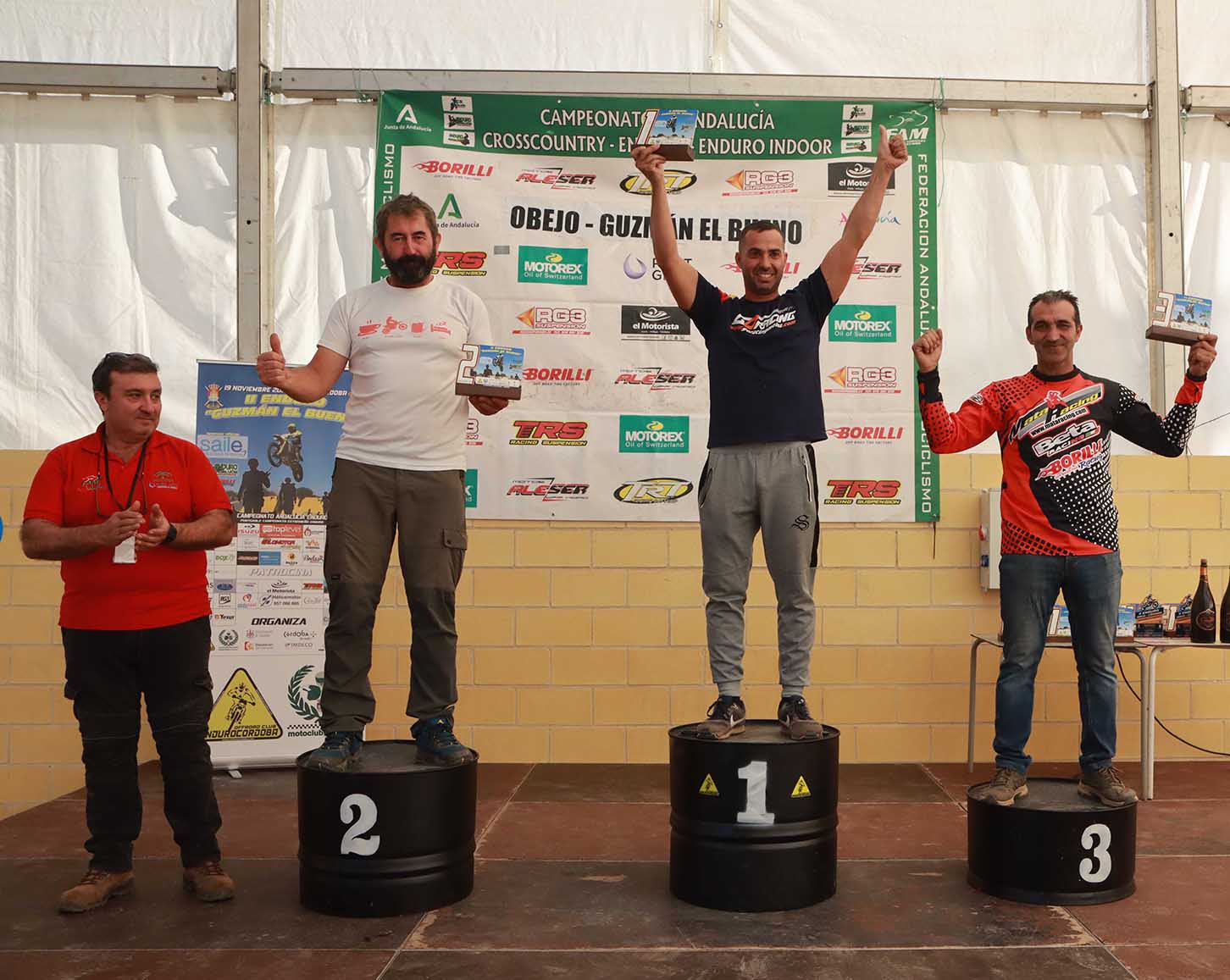
A partir de las 15:30 h del 19 de noviembre de 2023 tuvo lugar la ceremonia de entrega de trofeos del II Enduro Guzmán el Bueno Obejo-Cerro Muriano (Junior Sub-23, Senior-A, Senior-C, Master-45, Aficionados, Senior-B, Copa Pont-Grup Seguros y Trofeo Social Enduro), presidida por Antonio Ramón Martín (Delegado de Deportes de la Diputación de Córdoba), Pedro López Molero (Alcalde del Ayuntamiento de Obejo-Cerro Muriano), Juan Manuel Galván (Delegado de Deportes de Extremadura), Antonio Mata (Delegado de la Federación Andaluza de Motociclismo), Rafael Pérez (Presidente del Enduro Córdoba Offroad Club) José Manuel Córdoba (Vicepresidente del Enduro Córdoba Offroad Club ) y Ángel Salazar (Tesorero del Enduro Córdoba Offroad Club).
Aquí vemos a José Manuel Córdoba (Vicepresidente del Enduro Córdoba Offroad Club ) haciendo entrega a Pedro López Molero (Alcalde de Obejo-Cerro Muriano) de una placa conmemorativa del Enduro Córdoba Offroad Club y el Motoclub Posadas como reconocimiento al Ayuntamiento de Obejo-Cerro Muriano por su apoyo incondicional al deporte cordobés.
Ángel Salazar, Tesorero del Enduro Córdoba Offroad Club haciendo entrega de una placa conmemorativa a Antonio Ramón Martín (Delegado de Deportes de la Diputación de Córdoba) como reconocimiento a la Delegación de Deportes de la Diputación de Córdoba por su apoyo al deporte cordobés.
José Manuel Córdoba (Vicepresidente del Enduro Córdoba Offroad Club) con los campeones en Categoría Senior A : Sergio Navarro (1º), Alejandro Navarro (2º) y Enrique Pedraza (3º).
Rafael Pérez (Presidente del Enduro Córdoba Offroad Club) con Sergio Navarro, Alejandro Navarro y Enrique Pedraza, campeones en Categoría Senior A.
Rafael Pérez y Enrique Pedraza se abrazan justo después de la entrega de trofeos a los vencedores en Categoría Senior A.
De izquierda a derecha : Ángel Salazar (Tesorero del Enduro Córdoba Offroad Club), Rafael Pérez (Presidente del Enduro Córdoba Offroad Club), Alejandro Navarro, Pedro López Molero (Alcalde del Ayuntamiento de Obejo-Cerro Muriano), Antonio Ramón Martín (Delegado de Deportes de la Diputación de Córdoba), José Manuel Córdoba (Vicepfresidente del Enduro Córdoba Offroad Club), Enrique Pedraza y Alejandro Navarro.
José Manuel Partida, segundo clasificado en Categoría Senior B, posa con su trofeo.
Cristóbal Manuel Rubio (1º), José Manuel Partida(2º) y David Tovar (3º), Campeones en Categoría Senior B.
David Tovar, tercer clasificado en Categoría Senior B, con su trofeo.
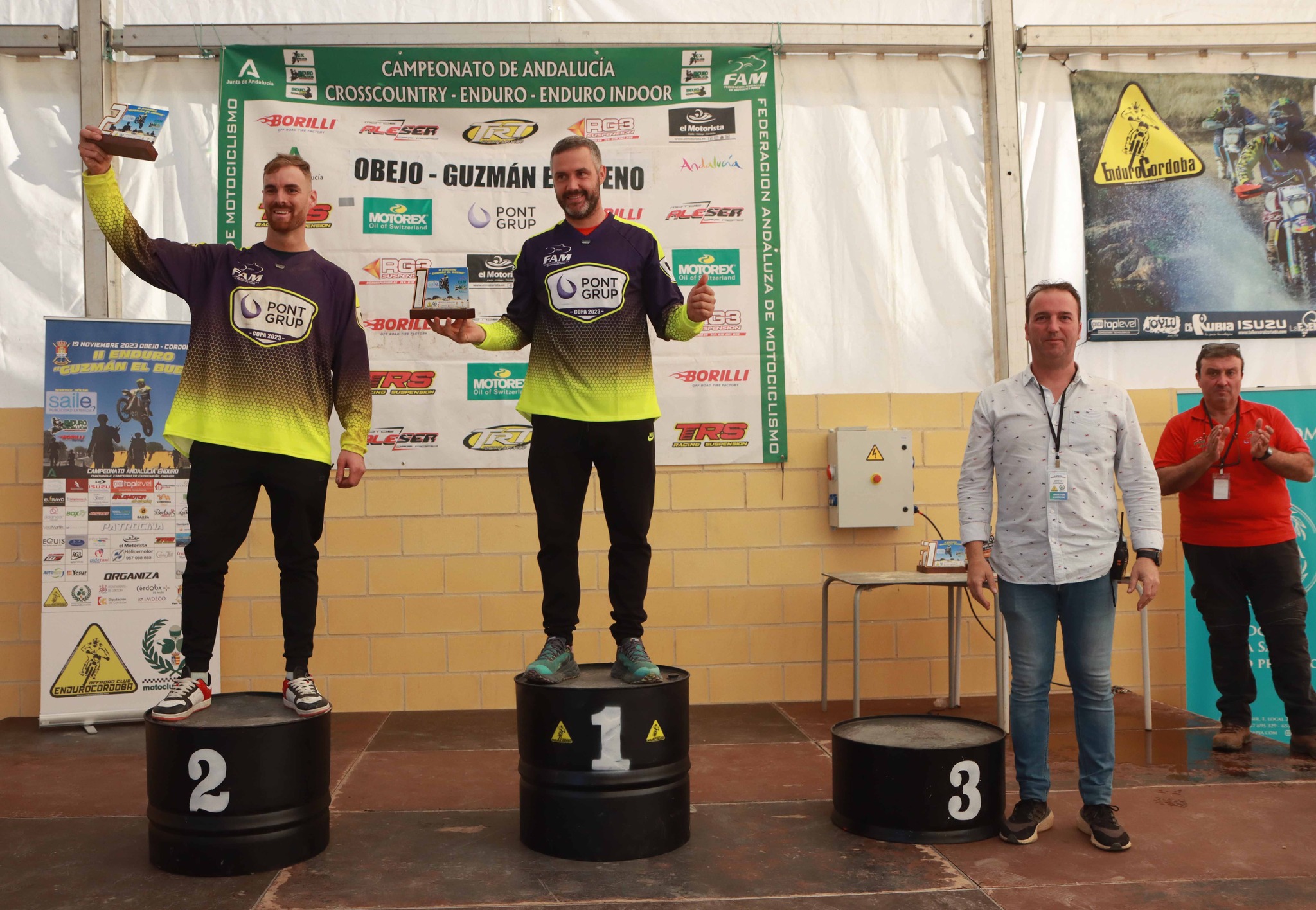
Rubén Palmar, segundo clasificado en Categoría Pont Grup Seguros, posando con su trofeo.
Rubén Palmar (1º) y Jaime Jaén (2º), Campeones en Categoría Pont Grup Seguros, en el pódium con sus trofeos, entregados por José Córdoba (Vicepresidente del Enduro Córdoba Offroad Club), mientras al fondo a la derecha aparece apaudiendo Antonio Mata (Delegado de la Federación Andaluza de Motociclismo).
Jaime Jaén, 2º clasificado en categoría Pont Grup Seguros, posando con su trofeo.
José Fernando González Marín (izquierda, 2º clasificado en categoría Diversion Extremadura, estrecha la mano de Francisco José Naranjo Carrasco (derecha, 3er clasificado en dicha categoría), pocos segundos antes de subir a lo más alto del pódium Juan José Hernández Tornavilla (1er clasificado).
Juan José Hernández Tornavilla (1º), José Fernando González Marín (2º) y Francisco José Naranjo Carrasco (3º), Campeones en Categoría Diversion Extremadura, en el pódium.
Juan José Hernández Tornavilla (1º), José Fernando González Marín (2º) y Francisco José Naranjo Carrasco (3º), Campeones en Categoría Diversion Extremadura, en el pódium, posando con sus trofeos, entregados por Juan Manuel Galván (Delegado de Deportes de Extremadura), a la izquiera de la imagen.
José Fernando González Marín, 2º clasificado en Categoría Diversion Extremadura, posando con su trofeo.
José María Rabadán Castilla, 2º clasificado en Categoría Amateur Campeonato de Extremadura, estrecha la mano de José Hoyos Sánchez ( 3er clasificado), pocos segundos antes de subir a lo más alto del pódium García Nieto Trinidad (1er clasificado).
García Nieto Trinidad (1º), José María Rabadán Castilla (2º) y José Hoyos Sánchez (3º) en el pódium de vencedores de categoría Amateur del Campeonato de Extremadura.
Paulino Torres (2º clasificado en Categoría Senior C Extremadura) estrecha la mano de Manuel Jesús Ramos (1er clasificado en Categoría Senior C Extremadura).
Manuel Jesús Ramos (1º) y Paulino Torres (2º), Campeones en Categoría Senior C Extremadura, posando en el pódium con sus trofeos, entregados por Juan Manuel Galván (Delegado de Deportes de Extremadura), visible a la izquierda.
José Luis Amador Cortés (1º), Antonio Vázquez Leal (2º) y Juan Manuel Galván Rodríguez, Campeones en Categoría Senior B Extremadura, posando sobre el pódium con sus trofesos entregados por Antonio Mata (Delegado de la Federación Andaluza de Motociclismo).
Francisco Cabezas Menacho (1er clasificado) y Pablo Ortega García (2º), campeones en Categoría Social Enduro, posando con sus trofeos, entregados por José Córdoba (Vicepresidente del Enduro Córdoba Offroad Club).
Francisco Cabezas Menacho, 1er clasificado en Categoría Social Enduro, en la que fue 2º Pablo Ortega García y 3º Luis Francisco Martínez Colorado.
Pablo Ortega García, segundo en categoría Social Enduro, posando con su trofeo.
Oliver Lima (1er clasificado), Francisco José García (2º) y Nordin Hamed (3º), campeones en Categoría Senior C Andalucía, mostrando sus trofeos, entregados por Patricia Molina, Directora de Química de Clínica Roma de Fisioterapia, mientras Antonio Mata, Delegado de la Federación Andaluza de Motociclismo, aplaude.
José Antonio Sánchez González (1er clasificado), José Antonio Sánchez Merino (2º) y José Antonio Sánchez González (3º), campeones en Categoría Master 45, mostrando sus trofeos, entregados por Antonio Mata (Delegado de la Federación Andaluza de Motociclismo).
Alejandro Céspedes (1er clasificado), Alejandro Malagón (2º) y José Miguel Castillo, campeones en Categoría Aficionados, mostrando sus trofeos, entregados por Ángel Salazar (Tesorero del Enduro Córdoba Offroad Club).
Santiago Martín (1er clasificado), Alberto Blanco (2º) y Cristóbal Pérez (3º), campeones en Categoría Sub-23, recibiendo sus trofeos de manos de Pedro López Molero (Alcalde del Ayuntamiento de Obejo-Cerro Muriano).
Santiago Martín (1er clasificado), Alberto Blanco (2º) y Cristóbal Pérez (3º), campeones en Categoría Sub-23, muestran sus trofeos mientras Pedro López Molero, Alcalde del Ayuntamiento de Obejo-Cerro Muriano aplaude.
EXHIBICIÓN ESTÁTICA DE FASTUOSAS MOTOS CLÁSICAS OFF ROAD REPLETAS DE HISTORIA Y GLAMOUR
La Joya de la Corona entre las motos clásicas off-road exhibidas durante el II Enduro Obejo-Cerro Muriano Guzmán el Bueno en noviembre de 2023 : una réplica exacta de la legendaria BMW R80GS patrocinada por Marlboro y Playboy con la que el piloto belga Gastón Rahier ganó el París-Dakar de 1985, tras feroz batalla con el piloto francés Hubert Auriol.
La presencia de esta bellísima máquina de dos ruedas, repleta de historia y aureola, fue posible gracias a la amabilidad de su dueño Óscar Ocaña, socio del Enduro Córdoba Off-Road Club.
Carlos, restaurador de motos de gran nivel, que honró con su presencia el II Enduro Cerro Muriano Guzmán el Bueno, al que trajo una moto Honda CR 250 de 1993 con motor dos tiempos, totalmente restaurada con piezas originales :
Aquí aparece su hijo pilotando con gran pericia la mencionada moto a pocos metros de la gran carpa cerca del polideportivo de Cerro Muriano.
Ángel Caballero, director del site motociclístico " Olor a Gasolina " ,
un medio online de gran nivel especializado en motos. Es la persona que realiza las entrevistas, con la inestimable ayuda de los cámaras Juan de León y Rafael Cañas.
Ángel Caballero y José Manuel Córdoba, bajando de su remolque otra moto icónica que estuvo presente en Cerro Muriano en exhibición estática los días 18 y 19 de noviembre de 2023 durante la celebración del II Enduro Obejo-Cerro Muriano Guzmán El Bueno : la Yamaha Teneré 660 del equipo Gauloises del París-Dakar 1986.
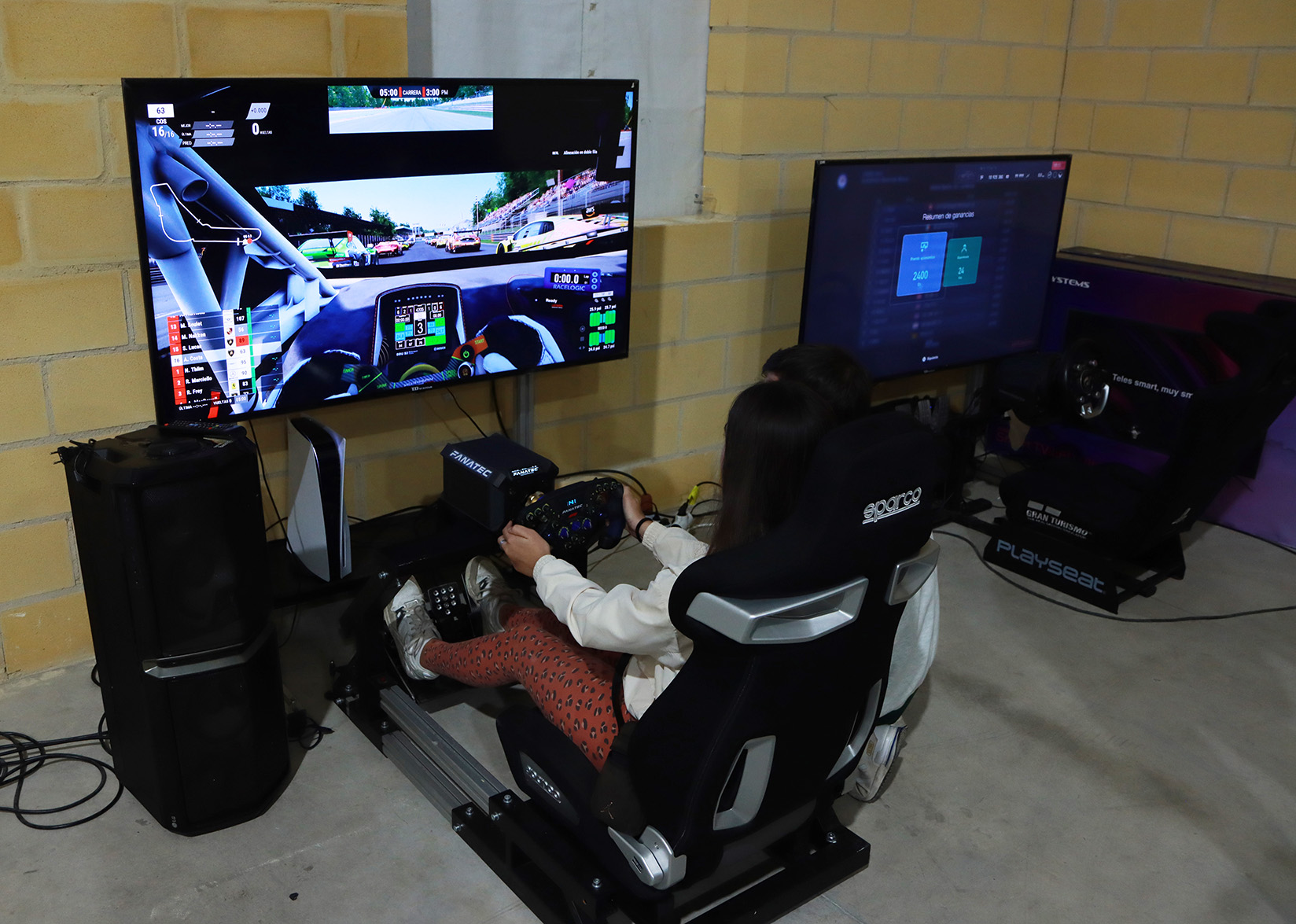
FABULOSO SCALEXTRIC Y SIMULADORES DE RALLY MONTADOS POR RAMÓN LUQUE
APOYO FUNDAMENTAL DE LA JUNTA DE ANDALUCÍA, LA DIPUTACIÓN DE CÓRDOBA, EL AYUNTAMIENTO DE CÓRDOBA, EL AYUNTAMIENTO DE OBEJO-CERRO MURIANO Y LA BRIGADA GUZMÁN EL BUENO
Tras 11 años de ímprobo esfuerzo y profundo amor por el motociclismo off road, el Enduro Córdoba Off Road Club, fundado en 2013, ha conseguido convertir un sueño en realidad : el III Enduro Obejo Cerro Muriano Guzmán El Bueno que se disputará el 23 y 24 de noviembre de 2024 será una competición valedera para el Campeonato de España de Enduro y en ella participarán muchos de los mejores pilotos del mundo de esta modalidad offroad.
De hecho, ya se han inscrito Josep García (Campeón del Mundo FIM Enduro 2 en 2017, Campeón del Mundo FIM Enduro 1 en 2023 y Campeón del International Six Days Enduro FIM 2023), Sergio Navarro (Campeón del Mundo Enduro Youth 2020, además de tres vecesd Campeón de España de Cross Country), y Enrique Pedraza (piloto cordobés del equipo El Motorista Rock & Cross, subcampeón de España de Enduro en categoría Senior B 4T en 2021 y Subcampeón de España de Cross Country en 2021 en Cuenca).
Si a ello añadimos que con los Enduro Obejo-Cerro Muriano Guzmán el Bueno 2022 y 2023 consiguieron la asistencia de nada menos que aproximadamente 11.000 espectadores, el trascendetal apoyo de la Diputación de Córdoba, Imdeco, el Ayuntamiento de Córdoba, el Ayuntamiento de Obejo-Cerro Muriano, la Delegación de Medio Ambiente de la Junta de Andalucía, la X Brigada Guzmán el Bueno de Córdoba, la presencia de marcas señeras del sector como KTM Racing, Beta, Husqvarna, Sherco, Rieju, 24MX, Greenland MX, Motos Aleser Off Road, Aleser Racing Suspensions, Borilli Off Road Tire Racing, El Motorista Rock & Cross, etc y el patrocinio de setenta y cinco entidades y empresas como Saile Publicidad Exterior, Borilli Racing, RG3, El Motorista, Pont Grup, TRT Racing Service, Aleser WP, FEX Moto, Enduro Andalucía, la Junta de Andalucía, Mudanzas Trassierra, Priego Galomotor Sherco, Hélice Motor, Cruzcampo, SMN Cars, Box 77 Motos, Domi Petrol SL Repsol, Mudanzas Trassierra, Bar Restaurante X, TopLevel Consultores Tecnológicos S.L, Extintores Bellido, Sector Oro, De la Rubia Soluciones Digitales, Instalaciones El Rayo, Santiago Carmona Cantera El Vértice, Cristalería Ciudad Jardín Camino de Los Sastres, Corduba Miel, Ari Maquinaria SCA, Sumninistros Sierra, Dalancor, J.M.G Competición, Aire Acondicionado Córdoba TotalClima, Grúas Barea, Bodas Outlet, La Esencia de Fátima, Hotal Abadi, etc.
todo ésto ha sido sin lugar a dudas un éxito sin precedentes en el ámbito del motociclismo offroad, porque el Enduro Córdoba Offroad Club es un colectivo pequeño de apasionados de esta modalidad motociclística, con muy pocos medios y 70 socios, pero con una descomunal pasión por el enduro, experiencia de muchas décadas, conocimiento muy profundo de este deporte y una tremenda capacidad de trabajo.
Pero que nadie se lleva a engaño.
A ninguno de los integrantes del Enduro Córdoba Offroad Club se les va a subir el éxito a la cabeza.
Saben quienes son y de donde vienen, además de que han tenido que luchar mucho para llegar hasta aquí, se han caído muchas veces y han vuelto a levantarse.
Son personas con mucha carretera corrida y experiencias acumuladas en el ámbito del motociclismo offroad en general y el enduro en particular.
Su éxito es el camino recorrido,
su principal aval es su ímprobo esfuerzo permanente, el estar siempre al pie del cañón,
el luchar hasta la extenuación y sacar horas de donde no las hay, el planificar todo con gran meticulosidad y con muchos meses de antelación,
Media hora antes de terminar el II Enduro Obejo-Cerro Muriano Guzmán El Bueno 2023, José Córdoba está literalmenten reventado de cansancio y comienza a faltarle el resuello.
Rafael Pérez (que también está al borde de la extenuación) lo percibe y se acerca a él, diciéndole unas palabras de apoyo. el ayudarse unos a otros en los momentos más difíciles, etc.
No quieren ser más que nadie y no están en ésto para exhibirse ni para obtener ningún tipo de lucimiento personal en absoluto, porque su objetivo fundamental es aportar su granito de arena para potenciar el deporte del enduro, darlo a conocer y generar nuevas vocaciones,
además de expresar su sincera gratitud y reconocimiento a personas que ya no están :
Francisco Javier Arribas Mesa, fallecido en 2018, toda una institución en la historia del motociclismo cordobés. Durante sus treinta años de carrera deportiva fue una referencia en las modalidades más extremas del motociclismo, como el motocross, el enduro, el dirt track y el cross country.
Rafael Ruiz " Plady " , Secretario del Enduro Córdoba Off Road Club. Fallecido en enero de 2024. Fue un enorme apasionado del enduro y el motociclismo offroad en general, con gran espíritu colaborador y una alegría contagiosa, además de caracterizarse por su gran impronta humana.
Ambos lo dieron todo por el motociclismo offroad, y con su contagiosa alegría y sempiterno idilio con el enduro, fueron en gran medida artífices conceptuales de la génesis del Enduro Obejo-Cerro Muriano Guzmán El Bueno, que el próximo noviembre de 2024 será valedero para el Campeonato de España de Enduro y reunirá a la flor y nata de los pilotos de enduro a nivel internacional, pero que será también en gran medida un homenaje a Javier Arribas " El Americano " , Rafael Ruiz " Plady " y el inmenso e inolvidable legado que dejaron.